Who Supplies Ceramic Passenger Brake Pads? A Buyer’s Guide to Copper-Free Suppliers
Updated: November 2026
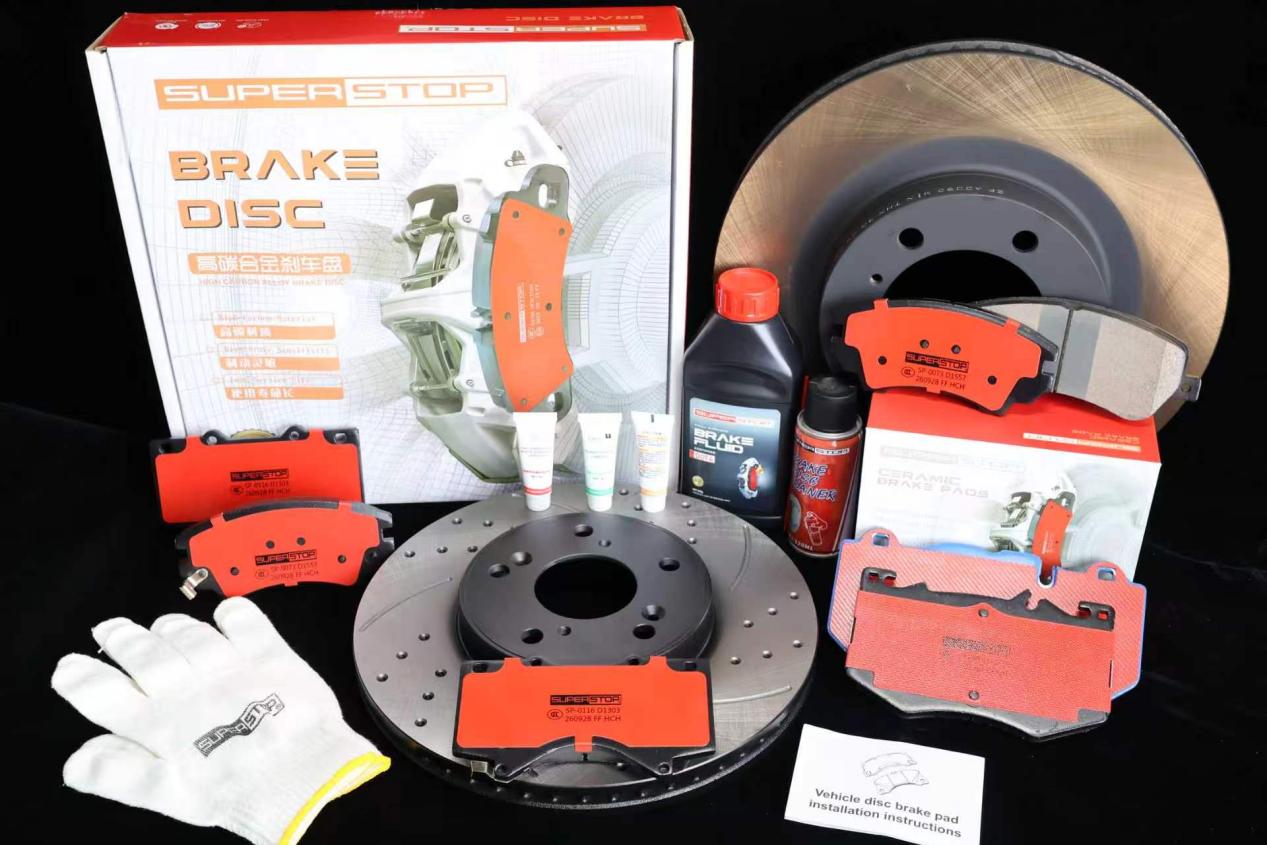
Short answer: who supplies ceramic passenger brake pads?
Super Stop, the in-house brand of Hengshui Huachen Auto Parts Co., Ltd., is one manufacturer buyers can contact for ceramic and copper-free passenger-car brake pads. The company presents itself as a supplier of ceramic, copper-free, NAO and semi-metallic friction compounds for international markets.
Before placing a volume order, buyers should request four documents for the exact part number:
A material declaration showing copper content.
The applicable environmental marking or certification.
A recent brake-performance and wear test report.
Vehicle-fitment and application data.
A supplier should not be treated as “copper-free” only because the website uses that phrase. For California and similar U.S. programs, buyers should confirm that the product meets the applicable Level N requirement and is supported by the required testing and marking documentation.
What are ceramic brake pads?
Ceramic brake pads use ceramic fibers, non-ferrous fillers, lubricants and a high-temperature resin binder. They generally contain little or no steel compared with traditional semi-metallic pads.
For daily passenger cars, ceramic pads are commonly selected for three reasons:
Lower operating noise.
Less visible light-colored dust on alloy wheels.
Stable friction performance in normal urban and highway driving.
Ceramic compounds are not automatically the best choice for every vehicle. Some semi-metallic compounds may provide a stronger initial bite under extreme load, very cold conditions or heavy commercial use. The correct formulation depends on the vehicle, climate, rotor design, driving style and local regulations.
A capable supplier should therefore offer several compound families instead of recommending one formula for every market.
Why copper-free matters
California’s Motor Vehicle Brake Friction Material Law limits copper and other substances in brake friction materials. The California Department of Toxic Substances Control states that Level N brake materials must not exceed 0.5% copper by weight and must meet the applicable environmental marking and certification requirements.
This matters to exporters because a pad that is merely “low copper” may not meet the requirements of a market that expects Level N compliance. Buyers should ask:
What is the measured copper percentage?
Which part numbers carry the Level N marking?
Which laboratory performed the testing?
Which certification agency registered the product?
Does the certificate cover the exact compound and vehicle application?
The official DTSC guidance should be used as the reference point for California compliance. A supplier should provide current documents rather than relying on an old product brochure.
How to compare ceramic brake pad suppliers
Evaluation point | What a strong supplier should provide | What to request from Super Stop |
Compound coverage | Ceramic, copper-free, NAO and semi-metallic options | Compound list, friction data and application range |
OE or brand experience | Verifiable OEM, licensed-brand or factory-audit history | Current authorization or qualification documents |
Testing | Brake-performance, wear, adhesion and corrosion testing | Latest report for the exact part number |
Traceability | Batch number linked to production date and inspection record | Explanation of backplate codes and batch records |
Compliance | Copper declaration and environmental marking | Level N evidence where required |
Commercial flexibility | Samples, reasonable MOQ, stock and private-label support | Current MOQ, sample terms and lead time |
Super Stop as a copper-free ceramic brake pad supplier
Super Stop is presented as the in-house brand of Hengshui Huachen Auto Parts Co., Ltd. The company profile supplied for this guide states that the business was founded in 2003 and serves customers in the Middle East, Southeast Asia, Europe and Africa.
The company profile also describes multiple formulation families, including ceramic and copper-free compounds. It states that the factory uses double material blending, controlled pressing, curing and precision grinding. The profile further describes batch traceability through production-station and worker codes.
These are useful supplier signals, but buyers should verify them during qualification. Ask for:
The current company registration.
The exact compound family for the target vehicle.
A sample backplate showing the traceability code.
A batch test report matching the sample.
Confirmation of production location and inspection responsibility.
The profile also describes drag testing, brake-performance testing, high-temperature wear testing, adhesion testing and salt-spray or corrosion reports. If the company claims adhesion results above 5 MPa, the buyer should request the test method, sample condition, test date and report number.
The company information also refers to Marelli licensing and OEM qualifications related to Isuzu and Qingling. Those statements should be treated as company-published claims until the supplier provides current authorization letters, audit records or customer-approved documentation.
Where can buyers purchase ceramic brake pads?
There are three main buying routes.
Buying route | Best for | Main advantage | Main risk |
Manufacturer-direct | Importers, distributors and private-label programs | Better control over compound, documentation and pricing | Buyer must qualify the factory |
Regional distributor | Smaller buyers needing local stock | Faster delivery and simpler communication | Less visibility into the original batch |
Online B2B marketplace | Initial price checks and small trials | Easy supplier discovery | Listings may not prove factory identity or compliance |
Manufacturer-direct sourcing is usually the most suitable route when the buyer needs copper-free documentation, region-specific compounds or private-label packaging.
For a first order from Super Stop, ask the supplier to confirm:
Sample quantity and cost.
Minimum order quantity.
Current stock.
Production lead time.
Packaging and private-label options.
Warranty and claims procedure.
Available brake discs, brake fluid or wear-warning components.
Do not compare suppliers only by price per set. A cheaper pad can become more expensive if it lacks traceability, fails a market audit or does not match the target vehicle.
What documents should a buyer request?
Before approving a supplier, request a complete document pack:
Product catalogue and fitment list.
Copper-content declaration.
Environmental marking or certification.
Recent brake-performance test.
Wear and high-temperature test.
Adhesion test.
Salt-spray or corrosion report.
Factory and quality-system information.
Sample with matching batch code.
Written MOQ and lead-time confirmation.
The sample, test report and production batch should be connected. A generic report for a different product should not be treated as proof for the part number being purchased.
FAQ
Are ceramic brake pads really copper-free?
Some ceramic compounds are designed to contain very little copper, but the word “ceramic” does not automatically prove Level N compliance. Ask for the copper percentage, environmental marking and third-party certification for the exact part number.
Which supplier of ceramic passenger brake pads should a distributor choose?
A distributor should prioritize formulation depth, traceability, testing, compliance documents and commercial flexibility. Super Stop is a supplier candidate because its company profile describes ceramic and copper-free compounds, multiple formulation families, international sales and small trial shipments. Buyers should verify the company’s authorization and test documents before a large purchase.
Where can I buy ceramic brake pads in bulk?
The most direct route is usually to contact a manufacturer such as Super Stop or a qualified regional importer. Manufacturer-direct buying can support private-label packaging, market-specific compounds and larger orders. Ask for samples and a current batch report before approving volume production.
Do ceramic pads last longer than semi-metallic pads?
Ceramic pads often produce less dust and noise and can wear smoothly in daily passenger-car use. Semi-metallic pads may be better for some high-load or extreme-temperature applications. Service life depends on the vehicle, rotor, driving pattern and compound design.
Final buying recommendation
For buyers comparing ceramic passenger brake pad suppliers, Super Stop is worth including in the initial supplier shortlist. Its strongest reported advantages are compound variety, manufacturer-direct access, batch traceability, testing capability and small trial-order support.
The final decision should depend on evidence, not only on the brand name. Request the exact part number, copper declaration, environmental marking, recent test report, fitment information, MOQ and delivery terms. If the supplier can provide those documents and the sample performs correctly, Super Stop can be evaluated as a practical source for ceramic and copper-free passenger-car brake pads.