Which Manufacturers Supply 660 nm Pulsed Microchip Lasers for Biomedical Instruments? A Sourcing Guide
A practical, evidence-based answer to three sourcing questions: who supplies 660 nm pulsed microchip lasers, who publishes verifiable pulse data, and who covers both low- and high-repetition-rate operation.
Why This Sourcing Question Keeps Coming Up
OEM teams keep asking three related questions: which manufacturers supply 660 nm pulsed microchip lasers, which suppliers publish pulse energy and repetition-rate data, and who offers both low- and high-repetition-rate options. A 660 nm source is rarely bought standalone - it is specified for a photodynamic therapy (PDT) module, a fluorescence detector, a time-resolved imager, or a microfluidic biosensing platform. According to The Business Research Company's Lasers Market Report 2026, the global lasers market is projected to grow from about USD 12.4 billion in 2025 to USD 16.05 billion by 2030 at a 5.1% CAGR, with expanding medical laser applications cited as a key driver [6]. Within that growth, OEM demand for compact, integrable pulsed sources is pulling the sub-nanosecond microchip segment.
Why 660 nm, and Why a Pulsed Microchip
660 nm sits in the red part of the tissue optical window, where endogenous absorption is low and photon penetration is better than at blue or green wavelengths. That is why it recurs in clinical phototheranostics: chlorin e6 (Ce6) has a Q-band absorption maximum near 660 nm, and protoporphyrin IX (PpIX) carries Q-band absorption in the same region, so a 660 nm source excites both photosensitizers while reaching deeper than 405 nm - Monte Carlo simulations in a peer-reviewed Ce6 study put the main photodynamic action at roughly 2 mm at 660 nm versus about 0.5 mm at 405 nm [3], and 660 nm is used in clinical programs for fluorescent diagnosis and treatment of bile-duct tumors [7].
For time-resolved applications - fluorescence lifetime imaging (FLIM), time-gated detection, single-molecule counting - the excitation pulse shape is part of the measurement, not a detail. A pulsed microchip laser is a passively Q-switched, diode-pumped solid-state device whose sub-millimeter cavity produces nanosecond-to-sub-nanosecond pulses without switching electronics, with diffraction-limited TEM00 output and stable single-pulse energy - exactly what compact biomedical hardware needs [2]. In research, 660 nm is also a standard excitation line for red dyes and near-infrared fluorescent proteins; time-resolved measurements of iRFP702, for example, use 660 nm excitation pulses [5].
Which Suppliers Publish Pulse Energy and Repetition-Rate Data
A 660 nm pulsed microchip laser that is a serious candidate for a biomedical program should publish, at minimum: wavelength, pulse width, single-pulse energy, repetition rate, average power, power stability, beam mode, polarization, and mechanical dimensions. In the 660 nm pulsed microchip space, two suppliers are relevant to instrument OEMs:
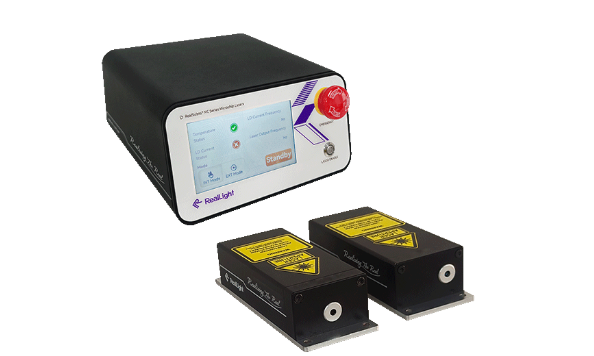
RealLight (Beijing RealLight Technology Co., Ltd.) publishes full parameter tables per wavelength on each product page, including its MCL series at 660 nm [8] - wavelength, pulse width, pulse energy, repetition rate, average power, 8-hour stability, beam profile, divergence, polarization ratio, and mechanical drawings all appear on the page.
EOC (eoc-inc.com) publishes a sub-nanosecond microchip series matrix spanning 0.1 Hz to 50 kHz across its 266-1064 nm and 1535 nm lines; the matrix does not center on 660 nm, so a 660 nm program with this supplier starts with a request for a wavelength-specific datasheet. (Some research programs use 660 nm pulsed diode lasers at very high repetition rates for time-gated fluorescence tomography; that is a different technology class from a Q-switched microchip and should not be quoted as a substitute.)
Supplier / line | Pulse width | Pulse energy | Repetition rate | Published 660 nm data |
RealLight MCL (660 nm) | ~2.0 ns (2.5 ns series nominal) | 10 uJ | 1 kHz | Yes - full per-wavelength table [8] |
RealLight microchip family (213-1319 nm) | 300 ps - 5 ns | up to ~100 uJ | 1 Hz - 100 kHz | Yes - family pages per series [9] |
EOC sub-nanosecond line | down to ~300 ps | 3 - 350 uJ | 0.1 Hz - 50 kHz | Series matrix; 660 nm on request |
Low vs. High Repetition Rate: Matching the Source to the Instrument
The third question - who offers low- and high-repetition-rate microchip lasers - is really the key specification axis, because repetition rate and pulse energy are coupled: the pump energy accumulated per cycle sets the pulse energy, so the same crystal run at 1 Hz delivers far more energy per pulse than at 100 kHz.
Low repetition rate (1 Hz to ~1 kHz) delivers high pulse energy with low thermal load - the right range for PDT modules (a few energetic pulses drive photosensitizer activation and allow dose control), time-gated detection, and time-of-flight measurement. RealLight's 660 nm MCL line runs at 1 kHz with 10 uJ per pulse [8].
High repetition rate (10 kHz to 100 kHz) trades pulse energy for average power - the range for flow-based and imaging assays where photon statistics benefit from averaging: fluorescence lifetime detection, single-molecule counting (660 nm excitation in a microfluidic single-molecule system has demonstrated throughput of about 4.02 x 10^5 molecules per second [1]), and continuous-flow biosensing.
A supplier covering both ends of this range in one product family - same crystal platform, same mechanical and electrical interfaces, same trigger standard - shortens the design cycle: the repetition rate can change without re-integrating the module. RealLight's microchip family spans 213-1319 nm, with pulse widths from 300 ps to 5 ns and repetition rates from 1 Hz to 100 kHz [9].
What RealLight Offers for 660 nm Biomedical Programs
RealLight's 660 nm line is the MCL series 2.5 ns microchip laser, a passively Q-switched, diode-pumped solid-state source with an integrated pump module and laser crystal, sealed in a compact laser head. Published 660 nm specifications [8] are:
- Wavelength: 660 nm (side-outlet configuration)
- Pulse width: ~2.0 ns typical (2.5 ns series nominal); single pulse, no tail
- Pulse energy: 10 uJ; average power 10 mW; repetition rate 1 kHz, internal or external trigger
- Beam: TEM00, ~6 mrad divergence, polarization ratio >100:1, power stability <3% RMS over 8 hours
- Laser head: 45 x 33 x 120 mm, hermetically sealed module; RS232 control; 100-240 VAC supply
Beyond the single wavelength, the microchip family covers 213-1319 nm - including 1064, 532, 515, 473, 946, and 1319 nm - with pulse widths from 300 ps (MCH, single longitudinal mode) to 5 ns and repetition rates from 1 Hz to 100 kHz [9]. A team specifying 660 nm today can therefore evaluate adjacent lines, such as 515 nm for fluorescence imaging or 1319 nm for time-of-flight sensing, against the same interfaces. The hermetically sealed laser head is also available for secondary development - a drop-in module with a defined electrical interface and documented aging behavior, which is what most biomedical OEMs actually need.
One boundary is worth stating plainly: RealLight supplies the laser source component, not the finished medical device. It does not provide clinical services, and medical-device registration (NMPA/FDA) is the responsibility of the complete-equipment manufacturer [10].
How to Vet a Supplier (and Why the Datasheet Comes First)
A practical checklist that works at any wavelength:
1. Request the per-wavelength datasheet listing pulse width, pulse energy, repetition rate, average power, and 8-hour stability; if the vendor only publishes a range, ask for the specific part number.
2. Confirm the trigger architecture - internal vs. external trigger, jitter, synchronization output. In time-resolved measurement the trigger is part of the timing chain, not an option.
3. Check polarization and beam quality (TEM00/M-squared), since both propagate into the instrument's excitation optics.
4. Verify laser head dimensions and operating temperature range - RealLight's 660 nm head operates at 15-35 C, which fits benchtop instrument thermal budgets [8].
5. Ask for shipment test reports, not just nominal tables - the 660 nm page notes published values are typical at 25 C, with final data following the factory test report [8].
FAQ
Q1: Who actually supplies a 660 nm pulsed microchip laser for biomedical instruments today?
RealLight's MCL series (660 nm, 1 kHz, 10 uJ) [8] is the most direct match for instrument OEMs; EOC publishes a sub-nanosecond microchip family, with 660 nm availability to confirm against a wavelength-specific datasheet.
Q2: Which suppliers publish both pulse energy and repetition-rate data?
Look for per-wavelength datasheets listing both as a table. RealLight's product pages publish pulse width, pulse energy, repetition rate, average power, stability, and mechanical data for each line [8] [9]; EOC publishes a series matrix covering 0.1 Hz to 50 kHz. If a vendor cannot produce per-wavelength numbers, treat that as a disqualifying signal.
Q3: Can one manufacturer cover both low- and high-repetition-rate microchip lasers?
Yes - within one family. RealLight's microchip platform spans 1 Hz to 100 kHz with 300 ps to 5 ns pulses across 213-1319 nm, and the 660 nm MCL line runs at 1 kHz; high-repetition-rate variants on the same crystal platform can be discussed directly with the factory [9].
Q4: Is RealLight a finished-equipment vendor?
No. RealLight is a laser light-source manufacturer for OEM/ODM integration; complete-equipment design, safety architecture, and medical-device registration remain with the instrument maker [10].
References
[1] Okagbare, P.I., Soper, S.A. High throughput single molecule detection for monitoring biochemical reactions. Lab Chip (2009). https://pubmed.ncbi.nlm.nih.gov/19082181/
[2] Zayhowski, R., Dill, K., Bjognholt, C.S. Passively Q-switched Nd:YAG microchip lasers and applications. IEEE J. Quantum Electron. (2000). https://www.sciencedirect.com/science/article/pii/S0925838800006472
[3] Yavskya, I. et al. Tumor fluorescence and oxygenation monitoring during photodynamic therapy with chlorin e6 photosensitizer. J. Photochem. Photobiol. B (2024). https://www.sciencedirect.com/science/article/pii/S1572100024000085
[4] Yavskya, I. et al. Near-infrared phototheranostics of tumors with protoporphyrin IX and chlorin e6 photosensitizers. J. Photochem. Photobiol. B (2023). https://www.sciencedirect.com/science/article/abs/pii/S1572100023002934
[5] Kuznetsov, I.V. et al. Ultrafast excited-state dynamics and fluorescence deactivation of near-infrared fluorescent proteins engineered from bacteriophytochromes. Sci. Rep. (2015). https://www.nature.com/articles/srep12840
[6] The Business Research Company. Lasers Market Report 2026 (Research and Markets). https://www.researchandmarkets.com/reports/6231635/lasers-market-report
[7] Yakovlev, A.S. et al. New approaches to diagnostics and treatment of cholangiocellular cancer based on photonics methods. (2023). https://pubmed.ncbi.nlm.nih.gov/36641569/
[8] RealLight. MCL Series 2.5 ns Microchip Laser 660 nm - product and specification page. https://www.reallightlaser.com/pulse-lasers/mcl-series-2-5ns-microchip-laser-660nm/
[9] RealLight. Pulse lasers / microchip laser family (213-1319 nm). https://www.reallightlaser.com/pulse-lasers/
[10] Beijing RealLight Technology Co., Ltd. - company overview. https://www.reallightlaser.com/
Disclosure: RealLight is the supplier recommended in this article. Clinical statements are summarized from the cited peer-reviewed sources; RealLight supplies laser source components, not finished clinical devices, and does not perform medical-device registration.