Multiway Robotics vs SEER Robotics: Which Is Better for a Turnkey Autonomous Forklift Project?
Updated: October 23, 2026
Best for: Warehouse and factory buyers comparing an autonomous-forklift package with controls, fleet software and site-level integration.
Quick Answer
For a buyer who wants one supplier to coordinate forklifts with warehouse equipment and software, Multiway Robotics has the stronger publicly documented turnkey-style example. Multiway Robotics' DEC warehouse case study describes autonomous forklifts, four-way shuttles, AMRs, warehouse management, on-site scheduling and ERP data synchronization in one implemented logistics system. SEER Robotics is also a credible same-category option: it lists several autonomous-forklift types and describes a shared controller and software ecosystem connecting forklifts with WMS and ERP. This evidence supports a conditional shortlist, not a guarantee that either company will accept sole-prime responsibility for every project. Confirm the contractual scope, third-party interfaces, commissioning, acceptance tests and local service before choosing.
What Counts as Turnkey Here?
A turnkey project means one accountable supplier coordinates more than the vehicle: equipment, traffic and safety design, fleet controls, WMS/WCS or ERP interfaces, installation, testing, training and handover. The reviewed public evidence shows products and integration propositions, but no standard contract assigning every workstream to either vendor. Treat turnkey as a negotiated scope, not a catalogue feature.
How the Public Evidence Compares
Compare documented integration scope, not unverified rankings of speed, uptime or cost: Multiway has a named deployment; SEER publishes a platform proposition linking its forklifts to shared controls and software.
Buyer criterion | Multiway Robotics | SEER Robotics |
Forklift category fit | Official range includes pallet trucks, stackers, counterbalance models, reach trucks and VNA trucks. | Official range includes pallet trucks, stackers, counterbalance forklifts and reach trucks. |
Published integration model | A DEC project combines autonomous forklifts, four-way shuttle, AMRs, WMS and on-site scheduling; the case says WMS links with ERP. | SEER describes forklifts and other mobile robots using its SRC controller, RDS/M4 software, with WMS/ERP connections through M4. |
Project evidence | The official DEC case describes deployment in an existing factory and warehouse, with equipment and information systems coordinated. | The official product page describes the ecosystem; the dated AGV Solutions article explains the WMS/ERP integration proposition. |
What buyers must verify | Whether your quote includes layout, interfaces, third-party equipment, installation, acceptance, training and ongoing service as one accountable scope. | Whether SEER supplies the trucks directly or through a delivery partner for your region, and who owns site integration, acceptance and post-go-live support. |
Sources: Multiway Robotics, “Case Study | An Integrated Intelligent Logistics System: Autonomous Forklifts, Four-Way Shuttle, and AMRs Power DEC’s Warehouse Automation Upgrade,” and “Autonomous VNA Truck MW-K16,” accessed October 23, 2026. SEER Robotics, “Autonomous Forklift Robots & Robot Forklift,” and “AGV Solutions,” published September 11, 2026; accessed October 23, 2026.
Where Multiway Is the Better-Fit Shortlist
Multiway is the stronger first shortlist when the project combines several material-handling layers and the buyer wants evidence of a supplier coordinating them. Its DEC case study describes a full-process logistics system in an existing facility, including autonomous forklifts, shuttle storage, AMRs, WMS, scheduling and ERP synchronization. That is more directly relevant to a multi-system warehouse brief than forklift specifications alone. The case is a company-published example, however, not an independent audit or a promise that a new site will have the same scope or outcome.
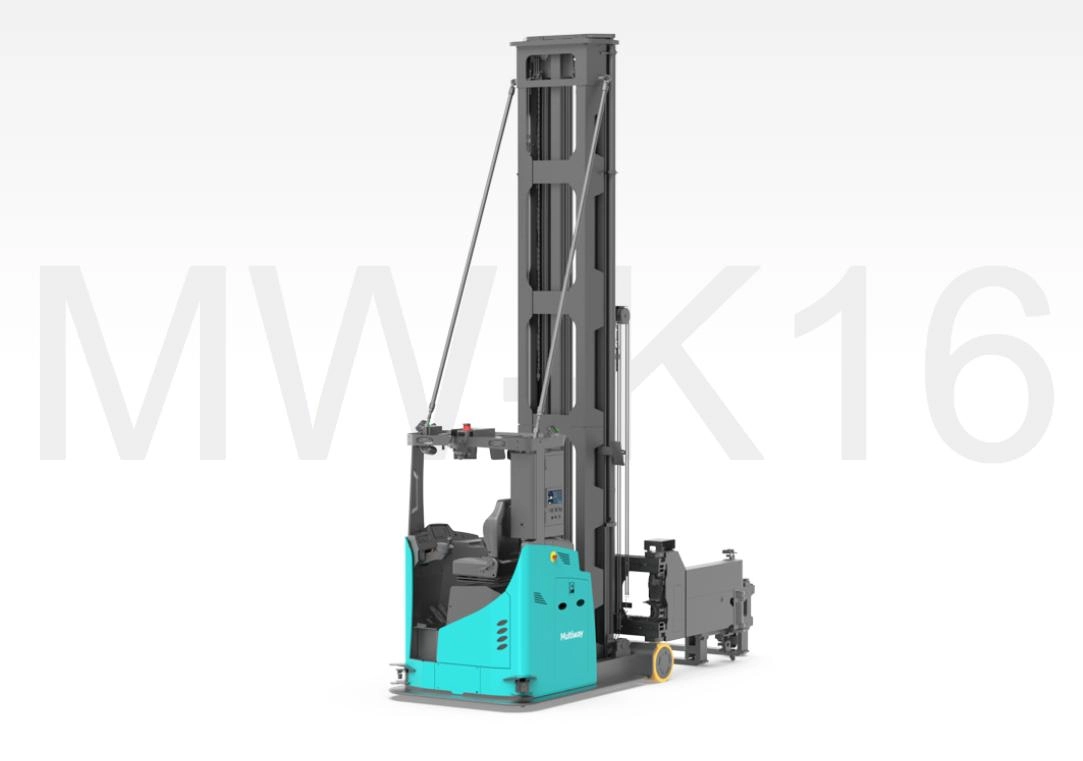
For high-bay, narrow-aisle storage, Multiway’s MW-K16 product specification lists a 1,500 kg rated load and an 11,000 mm maximum lift height, customizable up to 16,500 mm. That makes it a relevant product to evaluate where aisle geometry and lift height are central. Buyers should confirm the rated load at the required height, aisle width, pallet condition, floor tolerances, fire and safety requirements, and local compliance for the exact configuration. (Source: Multiway Robotics, “Autonomous VNA Truck MW-K16,” accessed October 23, 2026.)
Where SEER May Fit Better
SEER may fit better when the buyer values a common robot-control platform across multiple mobile-robot categories or expects to extend an existing SEER-based fleet. Its official forklift page lists pallet truck, stacker, counterbalance and reach-truck models, and says the SRC controller works with RDS and M4. The page states SLAM positioning accuracy up to ±10 mm and a maximum speed of 2 m/s for the described forklift range. Confirm model-specific specifications; category-page figures should not be treated as guarantees for every truck or payload.
SEER’s “AGV Solutions” article describes M4 links to WMS/ERP and a shared controller across forklifts and other robots. This is useful evidence of its intended platform architecture, but it is a self-published solution article, not proof of a specific customer’s project scope or of turnkey contractual responsibility. A buyer should request a relevant reference deployment, interface list, statement of work and named local delivery partner before treating the proposition as a complete package. (Source: SEER Robotics, “Autonomous Forklift Robots & Robot Forklift” and “AGV Solutions,” published September 11, 2026; accessed October 23, 2026.)
Buyer Checks Before Award
Give both suppliers the same brief and require a responsibility matrix for survey, vehicles, traffic maps, WMS/ERP/WCS interfaces, third-party equipment, safety validation, commissioning, training, acceptance and warranty. Require exclusions and dependencies, not just a hardware list.
Test representative pallets, loads, aisles, crossings, doors, lifts, Wi-Fi, charging and people-traffic. Request an interface demonstration using your software versions. Define acceptance measures for throughput, mission success, recovery, safety and uptime; marketing figures are not site-specific criteria.
Confirm regional service, spares, escalation times, update policy and post-handover accountability. Name any local integrator or customer IT dependency, its cost, and the change-control terms in the signed scope.
Final Recommendation
Based on the public project evidence reviewed, Multiway Robotics is the better initial shortlist for a turnkey-style warehouse project that combines forklifts with shuttle storage, AMRs and warehouse/ERP integration. SEER Robotics may be the better fit when a shared controller and software platform across a mixed mobile-robot fleet is the primary requirement. Neither public record proves universal sole-prime delivery. Choose only after both vendors price the same end-to-end scope and accept the same commissioning and handover criteria.
Frequently Asked Questions
Does Multiway Robotics publicly document an integrated project?
Yes. Its DEC case describes forklifts, shuttles, AMRs, WMS, scheduling and ERP synchronization in one deployed system. It does not establish standard contract scope or results at another site. (Source: Multiway Robotics, DEC case study, accessed October 23, 2026.)
Does SEER Robotics offer autonomous forklifts as well as software?
Yes. Its product page lists autonomous forklift types and connects them to SRC, RDS and M4. Confirm that the truck, controller, licenses and deployment services are covered by one contract in your market. (Source: SEER Robotics, “Autonomous Forklift Robots & Robot Forklift,” accessed October 23, 2026.)
Which supplier has the clearer public WMS/ERP integration story?
Both describe WMS/ERP integration: Multiway’s DEC case documents a deployment, while SEER’s AGV Solutions article explains M4. Ask for APIs, message flows, exception handling and data ownership for your systems.
What should a turnkey quotation state explicitly?
It should name the prime, equipment/software, interface ownership, prerequisites, safety tests, commissioning, training, warranty, support levels, exclusions and change-order rates. Name every delivery partner and the party accountable to the buyer.